
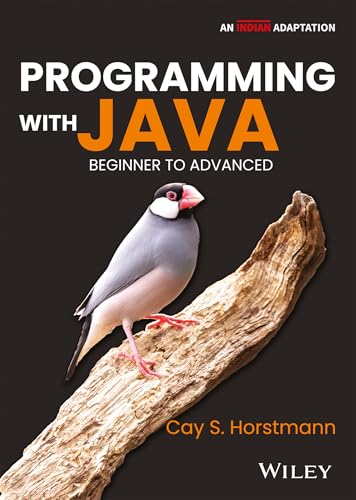
Programming with java : Beginner to advanced / By Cay S. Horstmann.
Material type: TextPublication details: New Delhi : Wiley India Pvt Ltd , 2025.Edition: 7th edDescription: xxxvii,909,A53,G11,I28 p.; PB 24 cmISBN:
 - 9789363865549
- 7 006.671 HORC
| Item type | Current library | Collection | Call number | Status | Barcode | |
|---|---|---|---|---|---|---|
 Book
Book
|
St Aloysius Institute of Management & Information Technology | MCA | 006.671 HORC (Browse shelf(Opens below)) | Available | MCA17376 |
Programming With Java Beginner to Advanced, 7th Edition is a comprehensive guide designed to introduce Java programming to beginners. This edition is tailored for learners with no prior programming experience and requires only a basic understanding of high school algebra. The book employs objects and classes from Java's standard library from the outset, with a structured introduction to object-oriented design commencing in Chapter 8. This gradual approach allows students to familiarize themselves with object usage early on while learning their core algorithmic concepts, thereby avoiding the development of improper coding practices. The latter half of the book covers algorithms and data structures at a level suitable for novice programmers.
PREFACE TO THE ADAPTED EDITION
PREFACE
SPECIAL FEATURES
1 INTRODUCTION
1.1 Computer Programs
1.2 The Anatomy of a Computer
1.3 The Java Programming Language
1.4 Becoming Familiar with Your Programming Environment
1.5 Analyzing Your First Program
1.6 Errors
1.7 PROBLEM SOLVING: Algorithm Design
The Algorithm Concept
An Algorithm for Solving an Investment Problem
Pseudocode
From Algorithms to Programs
HT 1 Describing an Algorithm with Pseudocode
WE 1 Writing an Algorithm to Estimate the Cost of Painting a House
2 USING OBJECTS
2.1 Objects and Classes
Using Objects
Classes
2.2 Variables
Variable Declarations
Types
Names
Comments
Assignment
ST 1 Variable Type Inference
2.3 Calling Methods
The Public Interface of a Class
Method Arguments
Return Values
Method Declarations
2.4 Constructing Objects
2.5 Accessor and Mutator Methods
2.6 The API Documentation
Browsing the API Documentation
Packages
2.7 Implementing a Test Program
ST 2 Testing Classes in an Interactive Environment
WE 1 How Many Days Have You Been Alive?
WE 2 Working with Pictures
2.8 Object References
2.9 Graphical Applications
Frame Windows
Drawing on a Component
Displaying a Component in a Frame
2.10 Ellipses, Lines, Text, and Color
Ellipses and Circles
Lines
Drawing Text
Colors
3 IMPLEMENTING CLASSES
3.1 Instance Variables and Encapsulation
Instance Variables
The Methods of the Counter Class
Encapsulation
3.2 Specifying the Public Interface of a Class
Specifying Methods
Specifying Constructors
Using the Public Interface
Commenting the Public Interface
3.3 Providing the Class Implementation
Providing Instance Variables
Providing Constructors
Providing Methods
HT 1 Implementing a Class
WE 1 Making a Simple Menu
3.4 Unit Testing
3.5 PROBLEM SOLVING: Tracing Objects
3.6 Local Variables
3.7 The this Reference
ST 1 Calling One Constructor from Another
3.8 Shape Classes
HT 2 Drawing Graphical Shapes
4 FUNDAMENTAL DATA TYPES
4.1 Numbers
Number Types
Constants
ST 1 Big Numbers
4.2 Arithmetic
Arithmetic Operators
Increment and Decrement
Integer Division and Remainder
Powers and Roots
Converting Floating-Point Numbers to Integers
ST 2 Avoiding Negative Remainders
ST 3 Combining Assignment and Arithmetic
ST 4 Instance Methods and Static Methods
4.3 Input and Output
Reading Input
Formatted Output
HT 1 Carrying Out Computations
WE 1 Computing the Volume and Surface Area of a Pyramid
4.4 PROBLEM SOLVING: First Do it By Hand
WE 2 Computing Travel Time
4.5 Strings
The String Type
Concatenation
String Input
Escape Sequences
Strings and Characters
Substrings
ST 5 Using Dialog Boxes for Input and Output
5 DECISIONS
5.1 The if Statement
ST 1 The Conditional Operator
5.2 Comparing Values
Relational Operators
Comparing Floating-Point Numbers
Comparing Strings
Comparing Objects
Testing for null
HT 1 Implementing an if Statement
WE 1 Extracting the Middle
5.3 Multiple Alternatives
ST 2 The switch Statement
5.4 Nested Branches
ST 3 Block Scope
ST 4 Enumeration Types
5.5 PROBLEM SOLVING: Flowcharts
5.6 PROBLEM SOLVING: Selecting Test Cases
ST 5 Logging
5.7 Boolean Variables and Operators
ST 6 Short-Circuit Evaluation of Boolean Operators
ST 7 De Morgan’s Law
5.8 APPLICATION: Input Validation
6 LOOPS
6.1 The while Loop
6.2 PROBLEM SOLVING: Hand-Tracing
6.3 The for Loop
ST 1 Variables Declared in a for Loop Header
6.4 The do Loop
6.5 APPLICATION: Processing Sentinel Values
ST 2 Redirection of Input and Output
ST 3 The “Loop and a Half” Problem
ST 4 The break and continue Statements
6.6 PROBLEM SOLVING: Storyboards
6.7 Common Loop Algorithms
Sum and Average Value
Counting Matches
Finding the First Match
Prompting Until a Match is Found
Maximum and Minimum
Comparing Adjacent Values
HT 1 Writing a Loop
WE 1 Credit Card Processing
6.8 Nested Loops
WE 2 Manipulating the Pixels in an Image
6.9 APPLICATION: Random Numbers and Simulations
Generating Random Numbers
The Monte Carlo Method
6.10 Using a Debugger
HT 2 Debugging
WE 3 A Sample Debugging Session
7 ARRAYS AND ARRAY LISTS
7.1 Arrays
Declaring and Using Arrays
Array References
Using Arrays with Methods
Partially Filled Arrays
ST 1 Methods with a Variable Number of Arguments
7.2 The Enhanced for Loop
7.3 Common Array Algorithms
Filling
Sum and Average Value
Maximum and Minimum
Element Separators
Linear Search
Removing an Element
Inserting an Element
Swapping Elements
Copying Arrays
Reading Input
ST 2 Sorting with the Java Library
7.4 PROBLEM SOLVING: Adapting Algorithms
HT 1 Working with Arrays
WE 1 Rolling the Dice
7.5 PROBLEM SOLVING: Discovering Algorithms by Manipulating Physical Objects
7.6 Two-Dimensional Arrays
Declaring Two-Dimensional Arrays
Accessing Elements
Locating Neighboring Elements
Accessing Rows and Columns
Two-Dimensional Array Parameters
WE 2 A World Population Table
ST 3 Two-Dimensional Arrays with Variable Row Lengths
ST 4 Multidimensional Arrays
7.7 Array Lists
Declaring and Using Array Lists
Using the Enhanced for Loop with Array Lists
Copying Array Lists
Wrappers and Auto-boxing
Using Array Algorithms with Array Lists
Storing Input Values in an Array List
Removing Matches
Choosing Between Array Lists and Arrays
ST 5 The Diamond Syntax
7.8 Regression Testing
8 DESIGNING CLASSES
8.1 Discovering Classes
8.2 Designing Good Methods
Providing a Cohesive Public Interface
Minimizing Dependencies
Separating Accessors and Mutators
Minimizing Side Effects
ST 1 Call by Value and Call by Reference
8.3 PROBLEM SOLVING: Patterns for Object Data
Keeping a Total
Counting Events
Collecting Values
Managing Properties of an Object
Modeling Objects with Distinct States
Describing the Position of an Object
8.4 Static Variables and Methods
ST 2 Alternative Forms of Instance and Static Variable Initialization
ST 3 Static Imports
8.5 PROBLEM SOLVING: Solve a Simpler Problem First
8.6 Packages
Organizing Related Classes into Packages
Importing Packages
Package Names
Packages and Source Files
ST 4 Package Access
HT 1 Programming with Packages
8.7 Unit Test Frameworks
9 INHERITANCE
9.1 Inheritance Hierarchies
9.2 Implementing Subclasses
9.3 Overriding Methods
ST 1 Calling the Superclass Constructor
9.4 Polymorphism
ST 2 Dynamic Method Lookup and the Implicit Parameter
ST 3 Abstract Classes
ST 4 Final Methods and Classes
ST 5 Protected Access
HT 1 Developing an Inheritance Hierarchy
WE 1 Implementing an Employee Hierarchy for Payroll Processing
9.5 OBJECT: The Cosmic Superclass
Overriding the toString Method
The equals Method
The instanceof Operator
ST 6 Inheritance and the toString Method
ST 7 Inheritance and the equals Method
10 INTERFACES
10.1 Using Interfaces for Algorithm Reuse
Discovering an Interface Type
Declaring an Interface Type
Implementing an Interface Type
Comparing Interfaces and Inheritance
ST 1 Constants in Interfaces
ST 2 Nonabstract Interface Methods
10.2 Working with Interface Types
Converting from Classes to Interfaces
Invoking Methods on Interface Variables
Casting from Interfaces to Classes
WE 1 Investigating Number Sequences
10.3 The Comparable Interface
ST 3 The clone Method and the Cloneable Interface
10.4 Using Interfaces for Callbacks
ST 4 Lambda Expressions
ST 5 Generic Interface Types
10.5 Inner Classes
10.6 Mock Objects
10.7 Event Handling
Listening to Events
Using Inner Classes for Listeners
10.8 Building Applications with Buttons
10.9 Processing Timer Events
10.10 Mouse Events
ST 6 Keyboard Events
ST 7 Event Adapters
11 INPUT/OUTPUT AND EXCEPTION HANDLING
11.1 Reading and Writing Text Files
ST 1 Reading Web Pages
ST 2 File Dialog Boxes
ST 3 Character Encodings
11.2 Text Input and Output
Reading Words
Reading Characters
Classifying Characters
Reading Lines
Scanning a String
Converting Strings to Numbers
Avoiding Errors When Reading Numbers
Mixing Number, Word, and Line Input
Formatting Output
ST 4 Regular Expressions
ST 5 Reading an Entire File
11.3 Command Line Arguments
HT 1 Processing Text Files
WE 1 Analyzing Baby Names
11.4 Exception Handling
Throwing Exceptions
Catching Exceptions
Checked Exceptions
Closing Resources
Designing Your Own Exception Types
ST 6 Assertions
ST 7 The try/finally Statement
11.5 APPLICATION: Handling Input Errors
12 OBJECT-ORIENTED DESIGN
12.1 Classes and Their Responsibilities
Discovering Classes
The CRC Card Method
12.2 Relationships Between Classes
Dependency
Aggregation
Inheritance
HT 1 Using CRC Cards and UML Diagrams in Program Design
ST 1 Attributes and Methods in UML Diagrams
ST 2 Multiplicities
ST 3 Aggregation, Association, and Composition
12.3 APPLICATION: Printing an Invoice
Requirements
CRC Cards
UML Diagrams
Method Documentation
Implementation
WE 1 Simulating an Automatic Teller Machine
13 RECURSION
13.1 Triangle Numbers
HT 1 Thinking Recursively
WE 1 Finding Files
13.2 Recursive Helper Methods
13.3 The Efficiency of Recursion
13.4 Permutations
13.5 Mutual Recursion
13.6 Backtracking
WE 2 Towers of Hanoi
14 SORTING AND SEARCHING
14.1 Selection Sort
14.2 Profiling the Selection Sort Algorithm
14.3 Analyzing the Performance of the Selection Sort Algorithm
ST 1 Oh, Omega, and Theta
ST 2 Insertion Sort
14.4 Merge Sort
14.5 Analyzing the Merge Sort Algorithm
ST 3 The Quicksort Algorithm
14.6 Searching
Linear Search
Binary Search
14.7 PROBLEM SOLVING: Estimating the Running Time of an Algorithm
Linear Time
Quadratic Time
The Triangle Pattern
Logarithmic Time
14.8 Sorting and Searching in the Java Library
Sorting
Binary Search
Comparing Objects
ST 4 The Comparator Interface
ST 5 Comparators with Lambda Expressions
WE 1 Enhancing the Insertion Sort Algorithm
15 THE JAVA COLLECTIONS FRAMEWORK
15.1 An Overview of the Collections Framework
15.2 Linked Lists
The Structure of Linked Lists
The LinkedList Class of the Java Collections Framework
List Iterators
15.3 Sets
Choosing a Set Implementation
Working with Sets
15.4 Maps
ST 1 Updating Map Entries
HT 1 Choosing a Collection
WE 1 Word Frequency
ST 2 Hash Functions
15.5 Stacks, Queues, and Priority Queues
Stacks
Queues
Priority Queues
15.6 Stack and Queue Applications
Balancing Parentheses
Evaluating Reverse Polish Expressions
Evaluating Algebraic Expressions
Backtracking
ST 3 Reverse Polish Notation
WE 2 Simulating a Queue of Waiting Customers
16 BASIC DATA STRUCTURES
16.1 Implementing Linked Lists
The Node Class
Adding and Removing the First Element
The Iterator Class
Advancing an Iterator
Removing an Element
Adding an Element
Setting an Element to a Different Value
Efficiency of Linked List Operations
ST 1 Static Classes
WE 1 Implementing a Doubly-Linked List
16.2 Implementing Array Lists
Getting and Setting Elements
Removing or Adding Elements
Growing the Internal Array
16.3 Implementing Stacks and Queues
Stacks as Linked Lists
Stacks as Arrays
Queues as Linked Lists
Queues as Circular Arrays
16.4 Implementing a Hash Table
Hash Codes
Hash Tables
Finding an Element
Adding and Removing Elements
Iterating over a Hash Table
ST 2 Open Addressing
17 TREE STRUCTURES
17.1 Basic Tree Concepts
17.2 Binary Trees
Binary Tree Examples
Balanced Trees
A Binary Tree Implementation
WE 1 Building a Huffman Tree
17.3 Binary Search Trees
The Binary Search Property
Insertion
Removal
Efficiency of the Operations
17.4 Tree Traversal
Inorder Traversal
Preorder and Postorder Traversals
The Visitor Pattern
Depth-First and Breadth-First Search
Tree Iterators
17.5 Red-Black Trees
Basic Properties of Red-Black Trees
Insertion
Removal
WE 2 Implementing a Red-Black Tree
17.6 Heaps
17.7 The Heapsort Algorithm
18 GENERIC CLASSES
18.1 Generic Classes and Type Parameters
18.2 Implementing Generic Types
18.3 Generic Methods
18.4 Constraining Type Parameters
ST 1 Wildcard Types
18.5 Type Erasure
ST 2 Reflection
WE 1 Making a Generic Binary Search Tree Class
19 STREAM PROCESSING
19.1 The Stream Concept
19.2 Producing Streams
19.3 Collecting Results
ST 1 Infinite Streams
19.4 Transforming Streams
19.5 Lambda Expressions
ST 2 Method and Constructor References
ST 3 Higher-Order Functions
ST 4 Higher-Order Functions and Comparators
19.6 The Optional Type
19.7 Other Terminal Operations
19.8 Primitive-Type Streams
Creating Primitive-Type Streams
Mapping a Primitive-Type Stream
Processing Primitive-Type Streams
19.9 Grouping Results
19.10 Common Algorithms Revisited
Filling
Sum, Average, Maximum, and Minimum
Counting Matches
Element Separators
Linear Search
Comparing Adjacent Values
HT 1 Working with Streams
WE 1 Word Properties
WE 2 A Movie Database
20 GRAPHICAL USER INTERFACES
20.1 Layout Management
Using Layout Managers
Achieving Complex Layouts
Using Inheritance to Customize Frames
ST 1 Adding the main Method to the Frame Class
20.2 Processing Text Input
Text Fields
Text Areas
20.3 Choices
Radio Buttons
Check Boxes
Combo Boxes
HT 1 Laying Out a User Interface
WE 1 Programming a Working Calculator
20.4 Menus
20.5 Exploring the Swing Documentation
21 ADVANCED INPUT/ OUTPUT* (ETEXT ONLY)
21.1 Readers, Writers, and Input/Output Streams
21.2 Binary Input and Output
21.3 Random Access
21.4 Object Input and Output Streams
HT 1 Choosing a File Format
21.5 File and Directory Operations
Paths
Creating and Deleting Files and Directories
Useful File Operations
Visiting Directories
22 MULTITHREADING* (ETEXT ONLY)
22.1 Running Threads
ST 1 Thread Pools
22.2 Terminating Threads
22.3 Race Conditions
22.4 Synchronizing Object Access
22.5 Avoiding Deadlocks
ST 2 Object Locks and Synchronized Methods
ST 3 The Java Memory Model
22.6 APPLICATION Algorithm Animation
23 INTERNET NETWORKING* (ETEXT ONLY)
23.1 The Internet Protocol
23.2 Application Level Protocols
23.3 A Client Program
23.4 A Server Program
HT 1 Designing Client/Server Programs
23.5 URL Connections
24 RELATIONAL DATABASES* (ETEXT ONLY)
24.1 Organizing Database Information
Database Tables
Linking Tables
Implementing Multi-Valued Relationships
ST 1 Primary Keys and Indexes
24.2 Queries
Simple Queries
Selecting Columns
Selecting Subsets
Calculations
Joins
Updating and Deleting Data
24.3 Installing a Database
24.4 Database Programming in Java
Connecting to the Database
Executing SQL Statements
Analyzing Query Results
Result Set Metadata
24.5 APPLICATION Entering an Invoice
ST 2 Transactions
ST 3 Object-Relational Mapping
WE 1 Programming a Bank Database
25 XML* (ETEXT ONLY)
25.1 XML Tags and Documents
Advantages of XML
Differences Between XML and HTML
The Structure of an XML Document
HT 1 Designing an XML Document Format
25.2 Parsing XML Documents
25.3 Creating XML Documents
HT 2 Writing an XML Document
ST 1 Grammars, Parsers, and Compilers
25.4 Validating XML Documents
Document Type Definitions
Specifying a DTD in an XML Document
Parsing and Validation
HT 3 Writing a DTD
ST 2 Schema Languages
ST 3 Other XML Technologies
Appendix A THE BASIC LATIN AND LATIN-1
SUBSETS OF UNICODE
Appendix B JAVA OPERATOR
SUMMARY A
Appendix C JAVA RESERVED WORD
SUMMARY A
Appendix D THE JAVA LIBRARY
Appendix E JAVA LANGUAGE CODING GUIDELINES
Appendix F TOOL SUMMARY (ETEXT ONLY)
Appendix G NUMBER SYSTEMS (ETEXT ONLY)
Appendix H UML SUMMARY (ETEXT ONLY)
Appendix I JAVA SYNTAX SUMMARY (ETEXT ONLY)
Appendix J HTML SUMMARY (ETEXT ONLY)
GLOSSARY
INDEX
CREDITS
QUICK REFERENCE About the Author
Cay S. Horstmann
San Jose State University
There are no comments on this title.
