
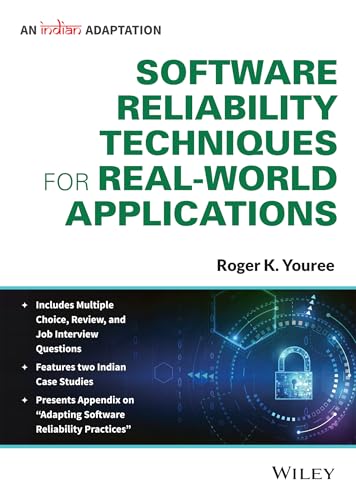
Software reliability techniques for real-world applications / By Roger K. Youree.
Material type: TextSeries: Wiley series in quality & reliability engineeringPublisher: Hoboken, NJ, USA : John Wiley and Sons, Ltd., 2023Description: 1 online resourceContent type:
 - text
- computer
- online resource
- 9789363863668
- 005.368 1 YOUR
- QA76.76.R44
| Item type | Current library | Collection | Call number | Status | Barcode | |
|---|---|---|---|---|---|---|
 Book
Book
|
St Aloysius Institute of Management & Information Technology | MCA | 005.368 YOUR (Browse shelf(Opens below)) | Available | MCA17382 |
Includes bibliographical references and index.
Table of Contents
Preface xi
Series Editor’s Foreword by Dr. Andre Kleyner xiii
Acronyms xv
Glossary xvii
1 Introduction 1
1.1 Description of the Problem 1
1.2 Implications for Software Reliability 2
References 3
2 Understanding Defects 5
2.1 Where Defects Enter the Project System 5
2.2 Effects of Defects 6
2.3 Detection of Defects 7
2.4 Causes of Defects 9
References 12
3 Handling Defects 13
3.1 Strategy for Handling Defects 13
3.2 Objectives 14
3.3 Plan 15
3.4 Implementation, Monitoring, and Feedback 28
3.5 Analogies Between Hardware and Software Reliability Engineering 31
References 33
4 Project Phases 35
4.1 Introduction to Project Phases 35
4.2 Concept Development and Planning 43
4.2.1 Description of the CDP Phase 43
4.2.2 Defects Typical for the CDP Phase 46
4.2.3 Techniques and Processes for the CDP Phase 47
4.2.4 Metrics for the CDP Phase 51
4.3 Requirements and Interfaces 62
4.3.1 Description of the Requirements and Interfaces Phase 62
4.3.2 Defects Typical for the Requirements and Interfaces Phase 63
4.3.3 Techniques and Processes for the Requirements and Interfaces Phase 65
4.3.4 Metrics for the Requirements and Interfaces Phase 68
4.4 Design and Coding 73
4.4.1 Description of the DC Phase 73
4.4.2 Defects Typical for the DC Phase 76
4.4.3 Techniques and Processes for the DC Phase 78
4.4.4 Metrics for the DC Phase 82
4.5 Integration, Verification, and Validation 91
4.5.1 Description of the IV&V Phase 91
4.5.2 Defects Typical for the IV&V Phase 94
4.5.3 Techniques and Processes for the IV&V Phase 96
4.5.4 Metrics for the IV&V Phase 98
4.6 Product Production and Release 105
4.6.1 Description of the Product Production and Release Phase 106
4.6.2 Defects Typical for the Product Production and Release Phase 107
4.6.3 Techniques and Processes for the Product Production and Release Phase 108
4.6.4 Metrics for the Product Production and Release Phase 111
4.7 Operation and Maintenance 115
4.7.1 Description of the Operation and Maintenance Phase 116
4.7.2 Defects Typical for the OM Phase 119
4.7.3 Techniques and Processes for the OM Phase 119
4.7.4 Metrics for the OM Phase 121
4.8 Management 125
4.8.1 Description of Management 125
4.8.2 Defects Typical for Management 126
4.8.3 Techniques and Processes for Management 128
4.8.4 Metrics for Management 131
References 139
5 Roadmap and Practical Guidelines 141
5.1 Summary and Roadmap 141
5.1.1 Start of a Project 142
5.1.2 As a Member of an Organization 145
5.1.3 Troubled Projects 145
5.2 Guidelines 149
References 150
6 Techniques 151
6.1 Introduction to the Techniques 151
6.2 Techniques for Systems Engineering 151
6.3 Techniques for Software 161
6.4 Techniques for Reliability Engineering 179
6.5 Project-Wide Techniques and Techniques for Quality Assurance 254
References 316
Index 323 About the Author
ROGER K. YOUREE is a Systems Scientist at Instrumental Sciences, Inc. Dr. Youree received his Doctorate degree in Applied Mathematics from the University of Alabama in Huntsville, USA, and has more than thirty-five years of experience with military, NASA, and commercial programs, including responsibilities such as planning, cost estimates, and progress tracking. Dr. Youree has extensive expertise in reliability engineering, including RAM Plan development, requirements development, modeling for allocation, predictions, and system improvement.
"Software controls a lot of aspects in our everyday lives, such as our home appliances, phones, cars, and many other computerized entertainment options. Because we are so dependent on it, it is important that software is reliable at all times, and this is where software reliability comes into play. Software reliability is the probability of a failure-free operation of a computer program / device and helps to find defects where humans are unable to do so. The importance of software reliability, along with its complexity and external constraints, mean that a software reliability program should be planned and implemented early in development and monitored and adjusted as needed"-- Provided by publisher.
Description based on print version record and CIP data provided by publisher; resource not viewed.
There are no comments on this title.
